Part 6 · August 26, 2026
National to Local Rollout Strategy
One Mission. One System. Every Detachment.
From the author
Part 6 of a series on MCL #Recruitment and #Retention that also addresses #Detachmentprogramming and activities. May this info be helpful for @everyone.
To catch the other posts, go to magnifying lens icon at top of this page and type in #Recruitment, #Retention, #DetachmentProgramming, or my name to see the various other posts.
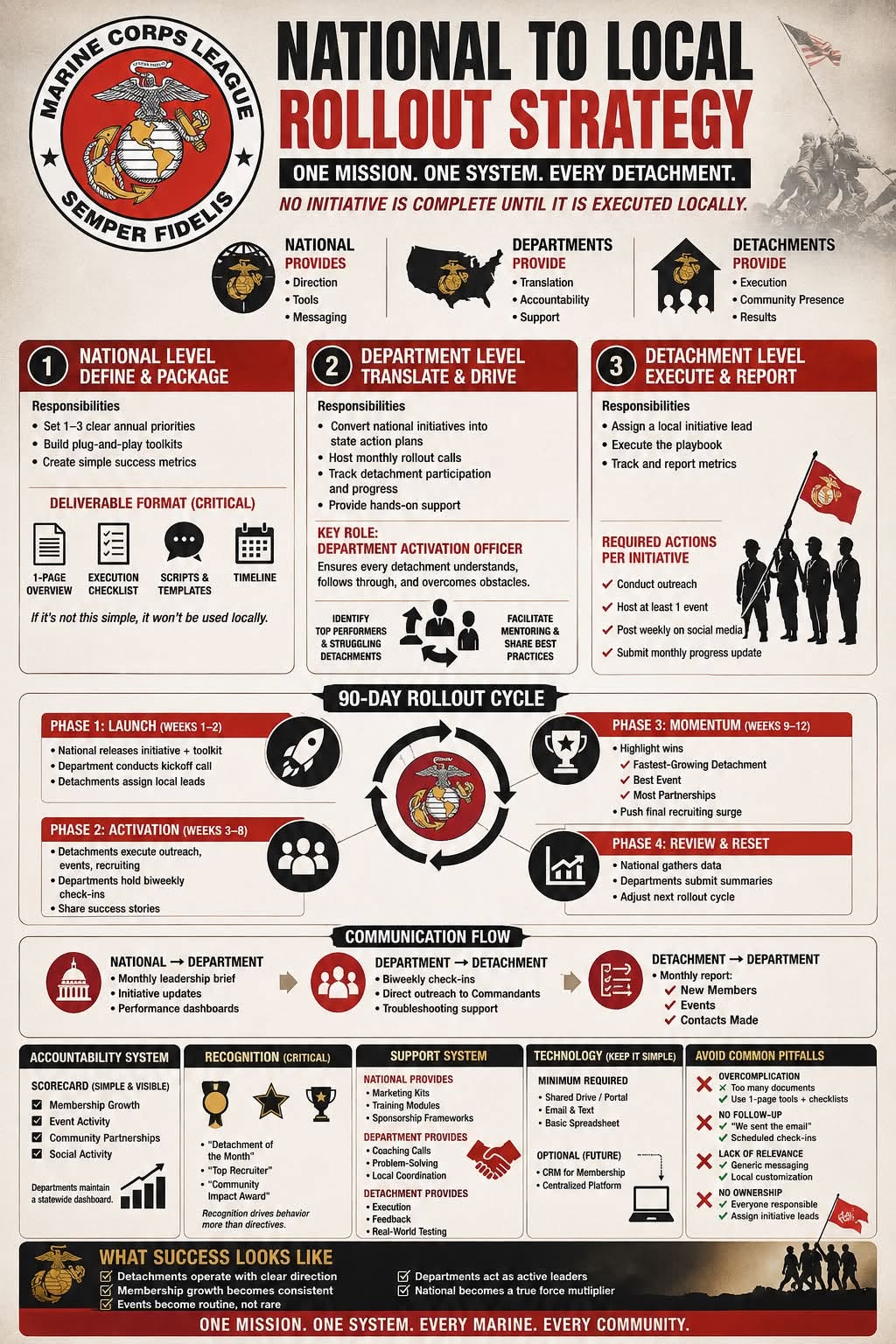
Here’s a national-to-local rollout strategy designed to help the Marine Corps League consistently translate national intent into local execution and results. This bridges the exact gap we identified: strategy exists at the top, but momentum must happen at the detachment level.
National-to-Local Rollout Strategy
Marine Corps League (MCL)
Objective
Create a repeatable system that converts national-level initiatives into measurable local detachment growth, visibility, and impact.
CORE PRINCIPLE
“No initiative is complete until it is executed locally.”
National provides:
- Direction
- Tools
- Messaging
Departments (State) provide:
- Translation
- Accountability
- Support
Detachments provide:
- Execution
- Community presence
- Results
STRUCTURE OF THE ROLLOUT SYSTEM
1. NATIONAL LEVEL: DEFINE & PACKAGE
Responsibilities
- Set 1–3 clear annual priorities (Example: Membership Growth, Community Visibility, Leadership Development)
- Build plug-and-play toolkits for each priority:
- Recruiting campaign kit
- Event playbook
- Sponsorship package
- Social media content
- Create simple success metrics:
- +X members per detachment
- X events per quarter
- X partnerships
Deliverable Format (Critical)
Every initiative must include:
- 1-Page Overview
- What this is
- Why it matters
- What success looks like
- Execution Checklist
- Step-by-step actions
- Scripts & Templates
- Recruiting conversations
- Sponsor outreach
- Social media posts
- Timeline
- Week-by-week guidance
If it’s not this simple, it won’t be used locally.
2. DEPARTMENT (STATE) LEVEL: TRANSLATE & DRIVE
Responsibilities
- Convert national initiatives into state-level action plans
- Host monthly rollout calls
- Track detachment participation and progress
- Provide hands-on support to struggling detachments
Key Role: “Department Activation Officer”
A dedicated role responsible for:
- Ensuring every detachment understands the initiative
- Following up weekly/biweekly
- Removing obstacles
Department Actions
- Identify:
- Top-performing detachments (models)
- Struggling detachments (priority support)
- Facilitate:
- Peer-to-peer mentoring
- Shared best practices
3. DETACHMENT LEVEL: EXECUTE & REPORT
Responsibilities
- Assign a local initiative lead
- Execute the provided playbook
- Track and report simple metrics
Required Actions per Initiative
- Conduct outreach (recruiting or partnerships)
- Host at least 1 event tied to initiative
- Post weekly on social media
- Submit a monthly progress update
ROLLOUT TIMELINE (90-DAY CYCLE)
PHASE 1: LAUNCH (Weeks 1–2)
- National releases initiative + toolkit
- Department conducts kickoff call
- Detachments assign local leads
PHASE 2: ACTIVATION (Weeks 3–8)
- Detachments execute:
- Outreach
- Events
- Recruiting
- Departments:
- Hold biweekly check-ins
- Share success stories
PHASE 3: MOMENTUM (Weeks 9–12)
- Highlight wins:
- Fastest-growing detachment
- Best event
- Most partnerships
- Push final recruiting surge
PHASE 4: REVIEW & RESET
- National gathers data
- Departments submit summaries
- Adjust next rollout cycle
COMMUNICATION FLOW
National → Department
- Monthly leadership brief
- Initiative updates
- Performance dashboards
Department → Detachment
- Biweekly check-ins
- Direct outreach to Commandants
- Troubleshooting support
Detachment → Department
- Monthly simple report:
- of new members
- of events
- of contacts made
ACCOUNTABILITY SYSTEM
Scorecard (Simple & Visible)
Each detachment tracks:
- Membership growth
- Event activity
- Community partnerships
- Social activity
Departments maintain a statewide dashboard
Recognition (Critical for Culture)
- Monthly highlights:
- “Detachment of the Month”
- “Top Recruiter”
- “Community Impact Award”
Recognition drives behavior more than directives
SUPPORT SYSTEM
National Provides:
- Marketing kits
- Training modules (short, practical)
- Sponsorship frameworks
Department Provides:
- Coaching calls
- Problem-solving
- Local coordination
Detachment Provides:
- Execution
- Feedback
- Real-world testing
TECHNOLOGY (KEEP IT SIMPLE)
Minimum required:
- Shared Google Drive or portal
- Email + text communication
- Basic tracking spreadsheet
Optional (future):
- CRM for membership tracking
- Centralized communication platform
COMMON FAILURE POINTS (AND FIXES)
1. Overcomplication
❌ Too many documents
Fix: 1-page tools + checklists
2. No Follow-Up
❌ “We sent the email”
Fix: Scheduled check-ins + accountability
3. Lack of Relevance
❌ Generic national messaging
Fix: Local customization encouraged
4. No Ownership
❌ Everyone responsible = no one responsible
Fix: Assign initiative leads at every level
WHAT SUCCESS LOOKS LIKE
After 2–3 rollout cycles:
- Detachments operate with clear direction
- Membership growth becomes consistent
- Events become routine, not rare
- Departments act as active leaders, not passive layers
- National becomes a true force multiplier
FINAL THOUGHT
The Marine Corps League doesn’t need more ideas.
It needs a system that ensures ideas turn into action at the local level—every time.
This rollout strategy creates that system.
Got a detachment that made one of these work — or one where it fell flat? Say so. Comments are read before they go up.