Part 5 · August 26, 2026
Should vs. Actual
What the MCL Delivers, and What Detachments Experience
From the author
Part 5 of a series on MCL #Recruitment and #Retention that also addresses #Detachmentprogramming and activities. May this info be helpful for @everyone.
To catch the other posts, go to magnifying lens icon at top of this page and type in #Recruitment, #Retention, #DetachmentProgramming, or my name to see the various other posts.
Here’s a direct, no-fluff mapping of what the Marine Corps League (MCL) should deliver at the National and Department (state) levels—compared to what many local Detachments actually experience—and where the biggest gaps (and opportunities) exist.
1. Legitimacy & Brand Power
What MCL Should Provide
- Nationally recognized Marine Corps–aligned credibility
- Strong, modern brand that resonates with younger veterans
- Clear public identity beyond “older veterans club”
What Often Happens Locally
- Brand feels dated and inward-facing
- Public doesn’t understand what the MCL actually does
- Recruiting message is unclear or irrelevant to post-9/11 Marines
Gap
Brand exists, but is not translating into local recruiting power
Opportunity
- Reposition MCL nationally as:
- “The place Marines continue serving after active duty”
- Provide detachments with:
- Ready-to-use recruiting campaigns
- Modern visuals, messaging, and digital assets
- Highlight impact stories, not just tradition
2. Advocacy & Representation
What MCL Should Provide
- Strong advocacy for veteran benefits and policy
- Representation at national/state legislative levels
What Often Happens Locally
- Members are not aware of advocacy efforts
- No clear connection between national work and local impact
Gap
Advocacy exists, but feels invisible and disconnected
Opportunity
- Push localized impact briefs:
- “Here’s what changed this year because of MCL—and how it affects you”
- Equip detachments with:
- Simple scripts to explain advocacy to recruits and donors
3. Resources & Operational Support
What MCL Should Provide
- Plug-and-play:
- Recruiting systems
- Event templates
- Sponsorship kits
- Clear “how to run a high-performing detachment” playbook
What Often Happens Locally
- Officers/Members figure it out on their own
- Knowledge is passed informally (and inconsistently)
- No standard for success
Gap
Resources exist in pockets, but no operational system
Opportunity
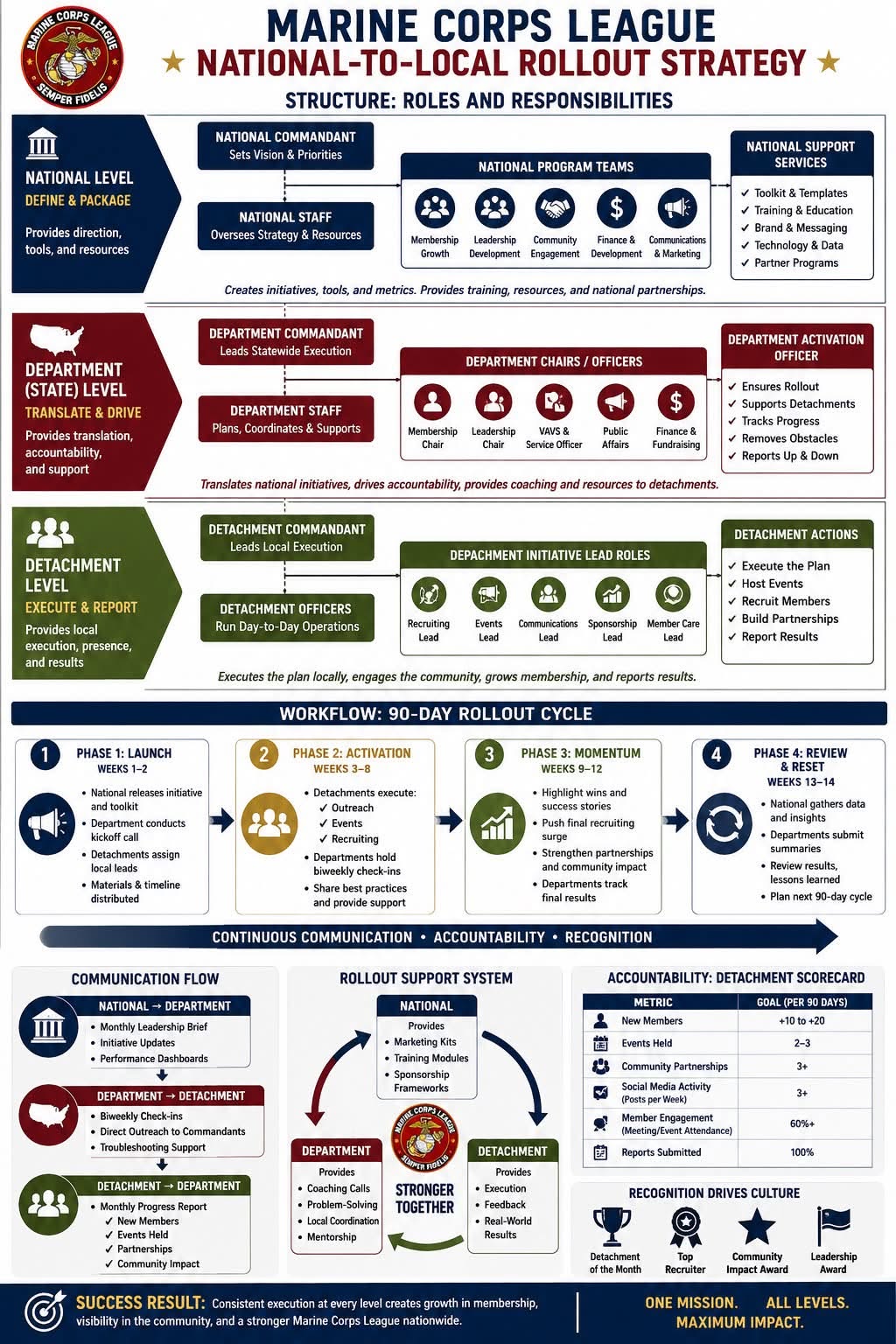
- Build a 90-day Detachment Success Kit:
- Step-by-step recruiting plan
- Event calendar templates
- Community partnership scripts
- Treat detachments like franchises with a playbook
4. Funding & Sponsorship
What MCL Should Provide
- National-level partnerships that trickle down
- Grant pipelines accessible to detachments
- Sponsorship frameworks
What Often Happens Locally
- Detachments rely on:
- Bar revenue
- Small raffles
- Little to no structured fundraising strategy
Gap
No scalable funding model at the local level
Opportunity
- Create a National Sponsor Program with local activation:
- Example: “This business supports Marines nationwide—and your local detachment”
- Provide:
- One-page sponsorship sheets
- Local business pitch scripts
- Teach detachments to operate like community nonprofits, not social clubs
5. Leadership Development
What MCL Should Provide
- Leadership pipeline for:
- Younger Marines
- Future detachment officers
- Training that is practical and ongoing
What Often Happens Locally
- Same leaders rotate positions
- Younger members are not stepping into leadership roles
- Burnout among core volunteers
Gap
No structured leadership pipeline
Opportunity
- Launch:
- “Future Detachment Leader” program (targeting post-9/11 vets)
- Provide:
- Micro-training (30-minute modules)
- Real-world leadership assignments
- Make leadership accessible, not intimidating
6. Marketing & Recruiting
What MCL Should Provide
- National recruiting campaigns
- Digital presence that appeals to modern veterans
- Clear value proposition
What Often Happens Locally
- Facebook pages are inactive or outdated
- Messaging focuses on:
- Meetings
- Uniforms
- Tradition
- Not on:
- Impact
- Camaraderie
- Continued service
Gap
Recruiting is left entirely to local effort—with no tools
Opportunity
- Provide:
- Social media content kits (weekly posts, graphics, videos)
- “First 5 conversations” scripts for recruiting younger vets
- Shift messaging to:
- “Find your tribe again”
- “Keep serving your community”
7. Network & Collaboration
What MCL Should Provide
- Active sharing of:
- Best practices
- Successful event models
- Growth strategies
What Often Happens Locally
- Detachments operate in isolation
- No structured sharing between high-performing and struggling units
Gap
Network exists, but is not leveraged
Opportunity
- Create:
- Monthly “Top Detachment Playbook” brief
- Peer-to-peer calls between detachments
- Highlight:
- “What worked in X city—and how to copy it”
8. Strategic Direction
What MCL Should Provide
- Clear, modern mission execution strategy
- Defined success metrics for detachments
What Often Happens Locally
- Focus drifts toward:
- Meetings
- Traditions
- Maintaining status quo
Gap
No measurable definition of a “successful detachment”
Opportunity
Define and track:
- Membership growth
- Community impact hours
- Event engagement
- New member retention
What gets measured gets improved
The Core Problem
The **Marine Corps League isn’t lacking purpose—it’s lacking translation.
National value is not being converted into local momentum
The Big Strategic Opportunity
Reposition the MCL from:
❌ “A legacy veterans organization you join” ➡️ TO
“A mission-driven network where Marines continue to serve, lead, and belong”
If Fixed, Here’s What Happens
- Younger veterans join—and stay
- Detachments become visible in their communities
- Funding becomes sustainable
- Leadership pipelines rebuild themselves
- The organization becomes relevant again at scale
Got a detachment that made one of these work — or one where it fell flat? Say so. Comments are read before they go up.