Part 13 · September 23, 2026
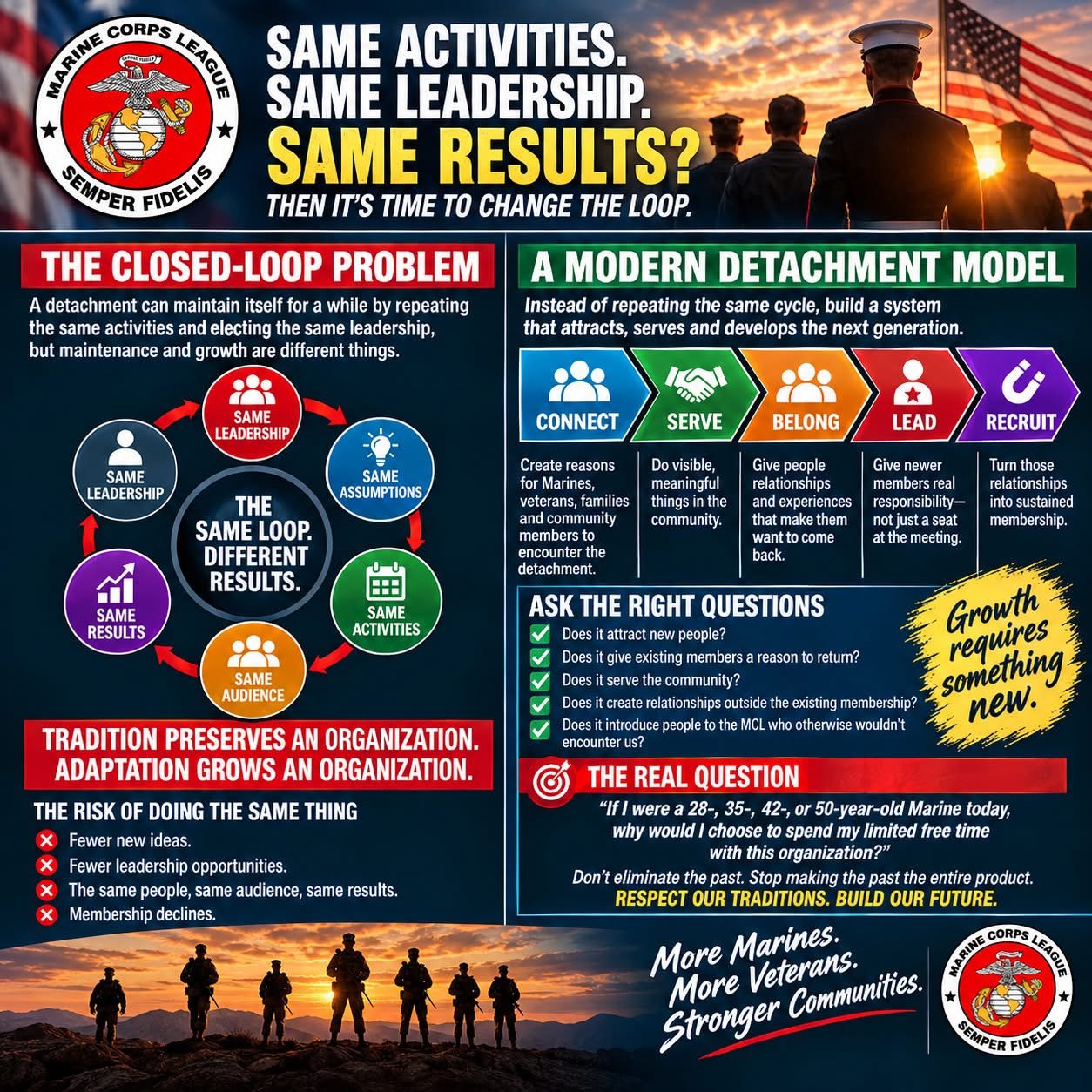
Same Activities. Same Leadership. Same Results?
Then It's Time to Change the Loop.
From the author
Part 13 of a series on MCL #Recruitment and #Retention that also addresses #Detachmentprogramming and activities. May this info be helpful for @everyone.
How does a Marine Corps League detachment thrive and grow by doing the same activities and electing the same leadership over and over?
It generally doesn't. A detachment can maintain itself for a while by repeating the same activities and electing the same leadership, but maintenance and growth are different things.
THE CLOSED-LOOP PROBLEM
The basic organizational problem is a closed-loop system:
Same leadership → same assumptions → same activities → same audience → same results → same leadership.
If membership is declining, repeating that loop is unlikely to reverse the trend.
WHAT HAPPENS WHEN A DETACHMENT OPERATES THIS WAY
| Pattern | Short-term result | Long-term effect |
|---|---|---|
| Same leaders | Stability | Fewer new ideas and fewer leadership opportunities |
| Same events | Familiarity | Eventually attracts the same people |
| Same meeting format | Predictability | Can discourage people who don't see a reason to attend |
| Same recruiting methods | Low friction for current members | Continues reaching the same demographic |
| Same decision-makers | Institutional memory | Can become institutional inertia |
| Same social circle | Strong internal relationships | New members remain outsiders |
| Same definition of success | Easy reporting | Problems can be normalized rather than solved |
The critical distinction is:
Tradition preserves an organization. Adaptation grows an organization.
THE LEADERSHIP ISSUE IS PARTICULARLY IMPORTANT
Electing the same people isn't inherently bad. Experienced leadership can be extremely valuable.
The problem occurs when leadership succession becomes leadership reproduction — when the organization repeatedly selects people who think, operate and recruit in essentially the same way.
A healthy detachment should continually create opportunities for:
- younger Marines and veterans to lead;
- newer members to propose programs;
- members who aren't part of the traditional inner circle to participate;
- people with different professional and community networks to contribute;
- emerging leaders to take responsibility before the organization desperately needs replacements.
A detachment shouldn't simply ask:
"Who can take the next office?"
It should ask:
"Who are we developing today who can lead this organization five years from now?"
ACTIVITIES HAVE THE SAME PROBLEM
There's nothing wrong with traditional MCL activities. The question is whether they are accomplishing today's objectives.
For every recurring activity, ask:
- Does it attract new people?
- Does it give existing members a reason to return?
- Does it serve the community?
- Does it create relationships outside the existing membership?
- Does it introduce people to the Marine Corps League who otherwise wouldn't encounter us?
If the answer is consistently "no," the activity may still be worthwhile — but it shouldn't be mistaken for a growth strategy.
CONFUSING ACTIVITY WITH PROGRESS
A detachment can be incredibly busy and still be shrinking.
For example:
- 12 meetings
- 8 traditional events
- 4 ceremonies
- 3 fundraisers
- 2 dinners
- 1 annual picnic
That sounds active. But if the result is the same 35 people, the same conversations, the same attendance and fewer members each year, then the organization isn't growing.
It's circulating.
Growth requires introducing something new into the system.
A BETTER MODEL
Instead of:
Membership → Meetings → Activities → Elections → Repeat
structure a modern detachment around:
CONNECT → SERVE → BELONG → LEAD → RECRUIT
- CONNECT — Create reasons for Marines, FMF Navy personnel, veterans, families and community members to encounter the detachment.
- SERVE — Do visible, meaningful things in the community.
- BELONG — Give people relationships and experiences that make them want to come back.
- LEAD — Give newer members real responsibility — not merely a seat at the meeting.
- RECRUIT — Turn those relationships into sustained membership.
Then measure whether it's working.
THE UNCOMFORTABLE QUESTION
A detachment facing declining membership shouldn't primarily ask:
"How do we get more people to join our organization?"
It should ask:
"If I were a 28-, 35-, 42-, or 50-year-old Marine today, why would I choose to spend my limited free time with this organization?"
If the honest answer is essentially, "Because we have always done these things, on these dates, with these people, and we hold our meetings this way…" then the problem isn't primarily recruiting.
It's the product being offered.
That's where the broader MCL strategy becomes important: the objective isn't to abandon the traditions that made the organization valuable. It's to add a contemporary reason for the next generation to participate.
Don't eliminate the past. Stop making the past the entire product.
Got a detachment that made one of these work — or one where it fell flat? Say so. Comments are read before they go up.