Part 12 · September 23, 2026
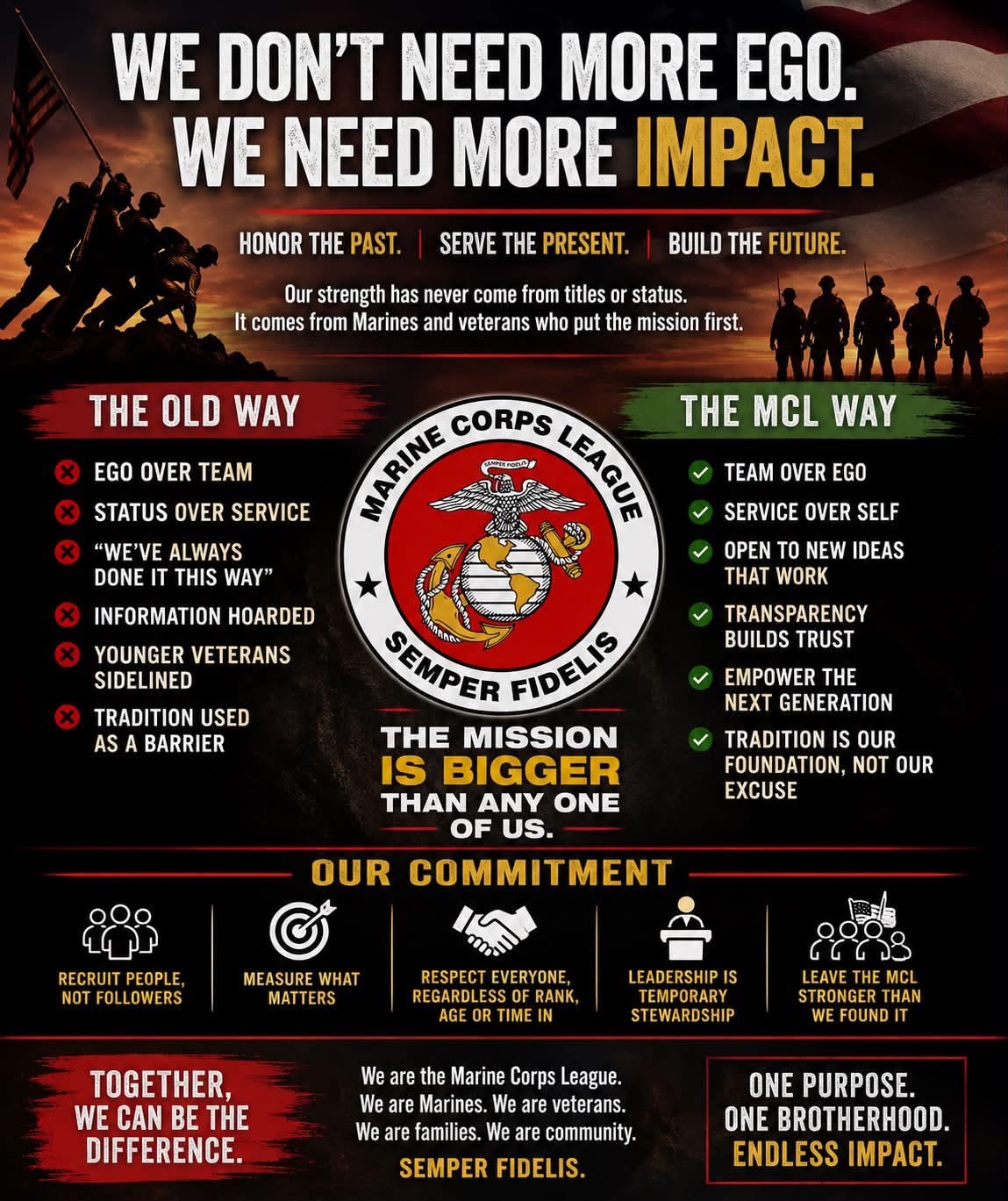
We Don't Need More Ego. We Need More Impact.
Honor the Past. Serve the Present. Build the Future.
From the author
Part 12 of a series on MCL #Recruitment and #Retention that also addresses #Detachmentprogramming and activities. May this info be helpful for @everyone.
To catch the other posts, go to the magnifying lens icon (search) at top of this page and type in #Recruitment, #Retention, #DetachmentProgramming, or my name to see the various other posts.
How do you combat grandiosity, peacocking, narcissism and a "good old boys" mentality that has plagued veteran service organizations for years?
You combat it by changing the system that rewards the behavior — not by trying to change the personalities first.
This is particularly important in veteran service organizations because the very qualities that can make someone a great Marine, soldier, sailor, airman, or leader — confidence, status, experience, strong identity, command presence — can become destructive when carried into a volunteer organization without accountability.
The objective shouldn't be to eliminate tradition, pride, or veteran camaraderie. It should be to separate legitimate earned respect from organizational entitlement.
THE FUNDAMENTAL SHIFT
Move from:
"I've been here longer, so I matter more."
to:
"What have I contributed lately, and how does it help the organization?"
And from:
"This is how we've always done it."
to:
"Does this still serve veterans and our community?"
1. STOP REWARDING STATUS
Grandiosity and peacocking thrive when titles, uniforms, medals, years of membership, past commands, and personal connections become currencies of power.
Create a culture where contribution outranks status.
Recognize people for:
- Recruiting new members
- Mentoring younger veterans
- Running successful programs
- Serving the community
- Raising money
- Bringing families into the organization
- Developing partnerships
- Showing up and doing the work
A 28-year-old veteran who brings in 10 new members and builds a successful community program should be able to have as much organizational influence as a 40-year member who hasn't participated in years.
2. ESTABLISH A "NO SACRED COWS" RULE
One of the biggest problems with a good-old-boys culture is that certain individuals become effectively untouchable.
The organization needs an explicit principle:
No individual is more important than the organization.
That includes:
- Past leaders
- Founding members
- Major donors
- Popular personalities
- Long-term members
- Current officers
- People with strong personal relationships inside the organization
Rules must apply equally.
3. MAKE MEETINGS ABOUT MISSION — NOT THEATER
A lot of dysfunctional organizations spend enormous amounts of energy on:
- Who sits where
- Who gets recognized
- Who gets offended
- Procedural arguments
- Personal disagreements
- Historical grievances
- "That's not how we do things"
Instead, every major discussion should eventually answer:
"How does this help us accomplish our mission?"
You can even put that question visibly on the meeting agenda.
4. SEPARATE RESPECT FROM DEFERENCE
This is crucial.
Older veterans deserve respect.
They don't automatically deserve control.
You can honor someone's 30 years of service while still saying:
"I respect everything you've done for this organization. But we're going to evaluate this proposal based on what is best for the organization today."
That's not disrespect.
That's governance.
5. PUT YOUNGER VETERANS IN REAL POSITIONS OF RESPONSIBILITY
Don't create a "Young Veterans Committee" and then give them a folding table in the corner.
Give them actual authority and accountability. For example:
NextGen Lead
- Owns recruitment
- Owns social media strategy
- Owns younger-veteran programming
- Has a defined budget
- Reports measurable results
Then judge them by performance.
This accomplishes two things simultaneously:
- Younger veterans gain legitimate organizational power.
- Older members learn that leadership is something you do, not something you permanently possess.
6. ATTACK NARCISSISM THROUGH TRANSPARENCY
You don't have to diagnose anyone as a narcissist.
Instead, build systems that make narcissistic behavior less effective:
Defined roles → defined authority → measurable objectives → transparent results.
For example:
| Leadership behavior | New standard |
|---|---|
| "I know everyone here." | Show measurable results |
| "I've been a member 35 years." | What are you contributing now? |
| "We've always done it this way." | What's the evidence it works? |
| "Young veterans don't understand." | Let them demonstrate what works |
| "That's my program." | Programs belong to the organization |
| "I brought in the donor." | Donor relationships belong to the organization |
| "I'm the only one who can do this." | Build a successor |
That last one is particularly important.
If somebody deliberately makes themselves indispensable, that's not leadership. That's organizational dependency.
7. ELIMINATE GATEKEEPING
Good-old-boys organizations often have invisible membership requirements:
- "You have to know somebody."
- "That's not really how we do things."
- "You need to earn your place."
- "We've got our way of doing things."
That mentality is poison for recruitment.
A new veteran should walk through the door and immediately know:
"These people are glad I'm here."
Not:
"I have to prove that I'm worthy to join their club."
8. CHANGE WHAT HAPPENS WHEN SOMEONE BEHAVES BADLY
Culture isn't defined by what leadership says.
It's defined by what leadership tolerates.
If somebody:
- Belittles younger veterans
- Bullies volunteers
- Hijacks meetings
- Uses their rank or past accomplishments to intimidate people
- Constantly demands recognition
- Creates interpersonal drama
- Blocks new ideas simply because they didn't originate them
- Treats the organization as their personal fiefdom
…the organization has to intervene.
Not with public humiliation. With professional accountability:
Private correction → documented expectation → consequences if repeated.
9. BUILD A "SERVICE BEFORE SELF" CULTURE
Ironically, veteran organizations sometimes lose the very principle that originally made military service meaningful.
The culture should repeatedly reinforce:
We didn't join the military to become important. We served something bigger than ourselves.
The same should be true after service.
The organization's question should become:
"What can I do for the next generation of veterans?"
rather than:
"What recognition am I getting?"
10. REDEFINE WHAT "TRADITION" MEANS
Don't attack tradition. Reclaim it.
Tradition isn't:
"We've always had the same people running everything."
Tradition is:
- "We take care of our own."
- "We honor those who served."
- "We never forget our fallen."
- "We serve our community."
- "We leave the organization stronger than we found it."
That gives older members something extremely important: a way to preserve their legacy without preserving their control.
THE CULTURAL RESET FOR AN MCL DETACHMENT
Make this a very simple organizational philosophy:
HONOR THE PAST.
We respect the Marines and veterans who built the organization.
SERVE THE PRESENT.
We exist to serve today's veterans, families, and community.
BUILD THE FUTURE.
We deliberately develop the next generation of leaders.
Then establish five cultural rules:
- No one is bigger than the League.
- Contribution matters more than tenure.
- Ideas are judged by results, not by who proposes them.
- Leadership is temporary stewardship, not permanent ownership.
- We recruit people — not followers.
That last distinction is powerful.
A healthy veteran organization should produce more leaders, not more people dependent upon a handful of personalities.
THE UNCOMFORTABLE TRUTH
You probably cannot reform a deeply entrenched good-old-boys culture by convincing the good old boys that they're wrong.
You'll get arguments. You'll get resistance. You'll hear:
- "We've tried that before."
- "Young people aren't interested."
- "We've been doing this for 40 years."
- "You're disrespecting the old members."
- "That's not how the League operates."
The answer isn't to fight those arguments individually.
Change the operating environment:
- Bring in new people.
- Give them responsibility.
- Create measurable programs.
- Make meetings productive.
- Celebrate contribution.
- Make information transparent.
- Enforce standards consistently.
And most importantly: make the organization more successful because of the new culture.
Eventually, the question stops being "Why are we changing?" and becomes:
"Why didn't we do this sooner?"
That is how you break the cycle without declaring war on the people who built the organization.
Got a detachment that made one of these work — or one where it fell flat? Say so. Comments are read before they go up.