Part 1 · August 26, 2026
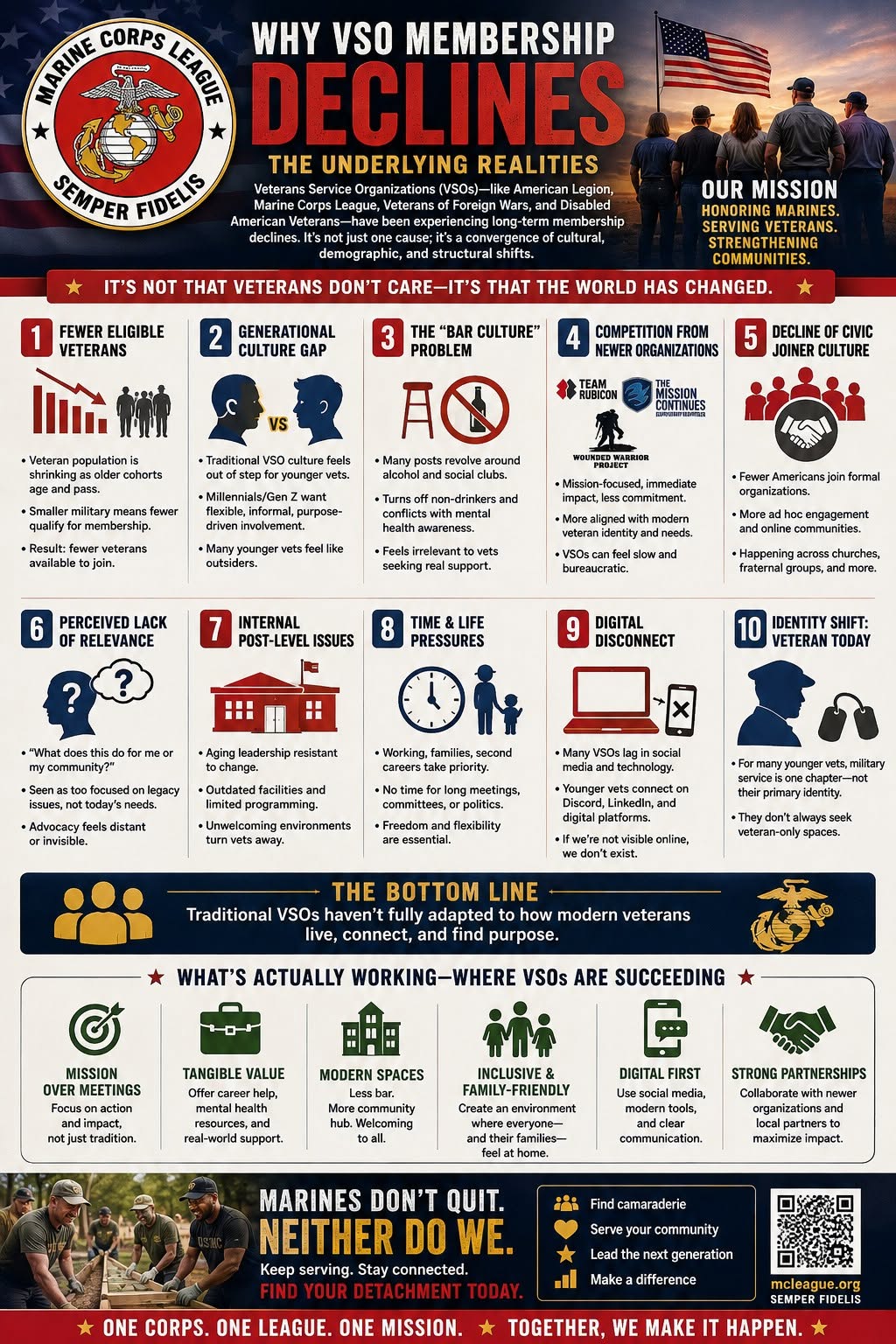
Why VSO Membership Declines
The Underlying Realities
#Recruitment #Retention #MCLMembership
From the author
Part 1 of a series of posts supporting #Recruitement and #Retention as well as #DetachementProgramming. To access all other posts, enter the hashtags in the search icon at the top of this screen, or search other posts made by me.
Why are veteran service organizations experiencing a decline? While this topic has been discussed several times over, it has never been compiled in such a full condense format as this. I challenge each and all of you read this evaluation and look at yourself, then look at your detachments with open eyes and see where your chips are stacked. It is my feel that a ’vast’ majority of detachments are not taking full advantage of the resources available to them and are living on traditions as an anchor - preventing you from moving to the future.
I will follow this post, next week, with suggestions on how to reverse your trend. The demand is @everyone needs to be a part of the solution.
Veterans Service Organizations (VSOs)—like American Legion, Marine Corps League, Veterans of Foreign Wars, and Disabled American Veterans—have been experiencing long-term membership declines. It’s not just one cause; it’s a convergence of cultural, demographic, and structural shifts.
Here are the real underlying reasons, without sugarcoating:
1. Fewer Eligible Veterans (Demographics Matter)
- The veteran population itself is shrinking. The massive WWII, Korea, and Vietnam cohorts are aging and passing away.
- Today’s military is smaller and more specialized, so fewer people qualify for VSO membership in the first place.
- Result: even if participation rates stayed constant, total membership would still drop.
2. Generational Culture Gap
- Older VSOs were built around traditions that resonated with mid-20th century veterans: formal meetings, uniforms, rituals, and bar-based social life.
- Post-9/11 veterans (Millennials/Gen Z) tend to prefer:
- Flexible, informal engagement
- Purpose-driven volunteering over meetings
- Less hierarchy and bureaucracy
- Many younger vets walk into a post and feel like outsiders.
3. The “Bar Culture” Problem
- A lot of local posts function primarily as social clubs centered on alcohol.
- That culture:
- Turns off veterans who don’t drink
- Conflicts with increased awareness of PTSD and substance abuse issues
- Feels irrelevant to vets looking for career support, mental health resources, or community impact
4. Competition from Newer, Niche Organizations
Modern groups are often more aligned with current veteran identity and needs:
- Team Rubicon (disaster relief)
- The Mission Continues (community service)
- Wounded Warrior Project (wellness & support)
These organizations:
- Offer clear missions
- Provide immediate impact
- Require less long-term commitment
VSOs can feel slow and bureaucratic by comparison.
5. Decline of Civic Joiner Culture (Big One)
This isn’t just VSOs—it’s happening across:
- Churches
- Fraternal groups (Elks, Moose, etc.)
- Rotary clubs
Americans in general are:
- Less likely to “join” formal organizations
- More likely to engage in ad hoc or online communities
- Less interested in monthly meetings and dues structures
6. Perceived Lack of Relevance
Many younger veterans ask:
“What does this organization actually do for me or my community?”
If the answer isn’t clear—or feels outdated—they disengage.
Common perceptions:
- Too focused on legacy issues
- Not enough emphasis on transition to civilian life (jobs, networking)
- Advocacy feels distant or invisible
7. Internal Post-Level Issues
At the local level, problems often include:
- Aging leadership resistant to change
- Poor facilities or outdated spaces
- Limited programming beyond social gatherings
- In some cases, unwelcoming environments (gender, race, or era bias)
One bad post experience can turn a veteran off permanently.
8. Time & Life Pressures
Younger veterans are often:
- Working full-time
- Raising families
- Building second careers
They don’t have the time for:
- Lengthy meetings
- Committee structures
- Organizational politics
9. Digital Disconnect
Many traditional VSOs:
- Lag in social media and digital engagement
- Have outdated websites or communication methods
Meanwhile, younger veterans organize via:
- Discord
- Informal networks
If an organization isn’t visible online, it effectively doesn’t exist to them.
10. Identity Shift: “Veteran” Means Something Different Now
- WWII/Korea/Vietnam vets often had a strong shared identity tied to service.
- Post-9/11 veterans:
- Often see military service as one chapter—not their primary identity
- Don’t always seek veteran-only spaces
The Bottom Line
Membership decline isn’t because veterans don’t care—it’s because:
Traditional VSOs haven’t fully adapted to how modern veterans live, connect, and find purpose.
What’s Actually Working (Where VSOs Are Succeeding)
Organizations or posts that are growing tend to:
- Focus on mission over meetings
- Offer tangible value (career help, mental health resources)
- Modernize spaces (less bar, more community hub)
- Create family-friendly and inclusive environments
- Use digital platforms effectively
- Partner with newer organizations instead of competing
Got a detachment that made one of these work — or one where it fell flat? Say so. Comments are read before they go up.