Part 3 · August 26, 2026
Stronger Together, Mission Accomplished
National and State Support. Local Impact.
From the author
Part 3 of a series on MCL #Recruitment and #Retention that also addresses #Detachmentprogramming and activities. May this info be helpful for @everyone.
A recurring question, “What does Nationals do for us [local detachment]?” The initial reply is, “What is your expectation; and is it realistic? Followed with, “What is your level of engagement on Department or National activities?” Followed with a final responsorial query of, “What is your understanding of a national organization?”
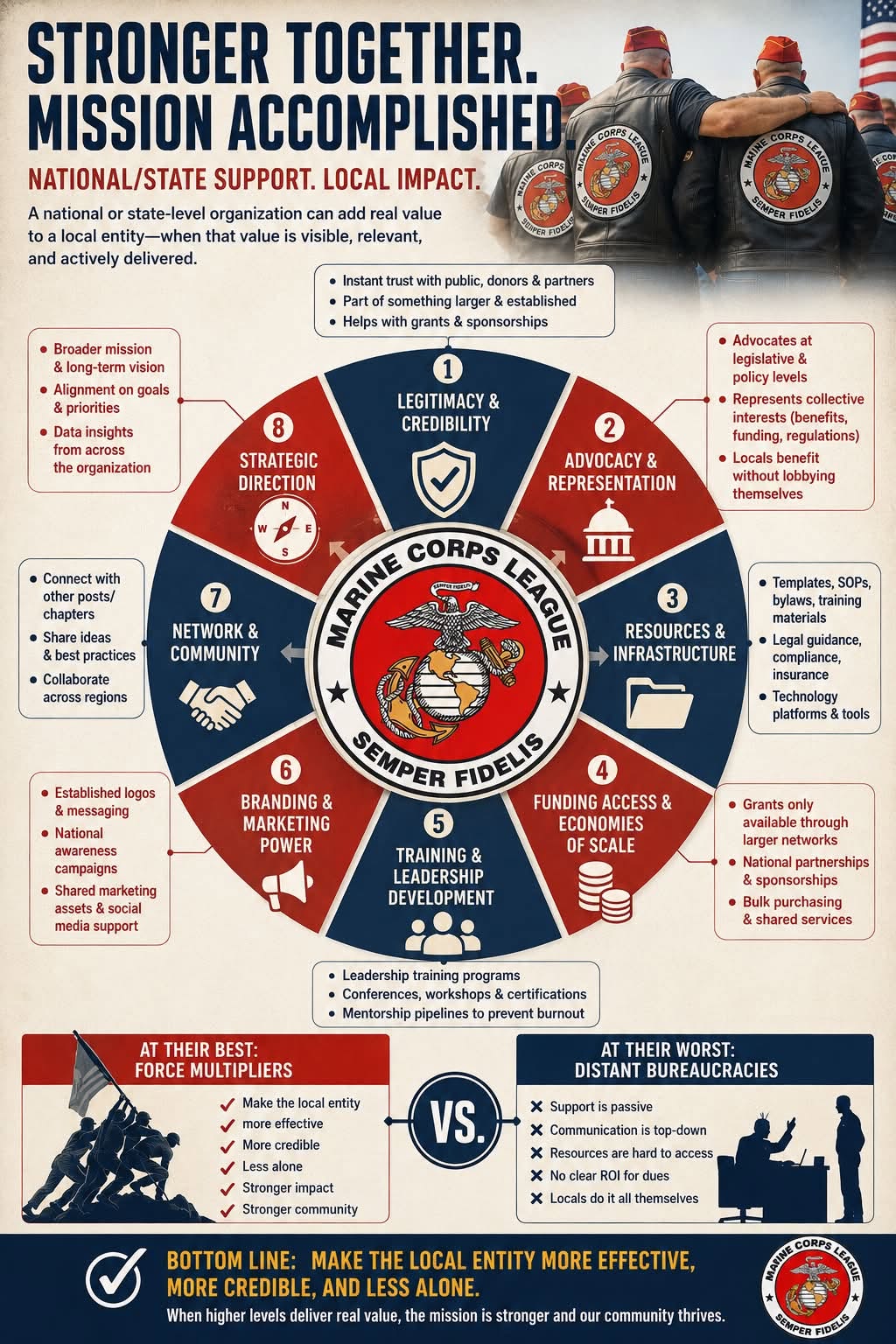
Regardless of the entity, a national or state-level organization can add real value to a local entity—but only if that value is visible, relevant, and actively delivered. At their best, they function as force multipliers. At their worst, they feel like distant bureaucracies. Here’s a clear breakdown of what they should bring to the local level:
1. Legitimacy & Credibility
- A recognized name lends instant trust with the public, donors, and partners
- Affiliation signals that the local group is part of something larger and established
- Helps with grant eligibility and sponsorship conversations
Example: A local detachment tied to a national brand often gets meetings and funding opportunities that an independent group wouldn’t.
2. Advocacy & Representation
- National / Department organizations advocate at legislative and policy levels
- They represent collective interests on issues like benefits, funding, or regulations
- Local entities benefit without needing to lobby themselves
This is especially critical for veteran, nonprofit, or civic groups.
3. Resources & Infrastructure
- Templates, SOPs, bylaws, training materials
- Legal guidance, compliance frameworks, insurance programs
- Technology platforms (membership systems, communications tools)
Saves local leaders time and reduces the need to “reinvent the wheel.”
4. Funding Access & Economies of Scale
- Grant opportunities only available through larger networks
- National partnerships or sponsorship pipelines
- Bulk purchasing power or shared services
Ideally, this lowers costs and increases funding potential locally.
5. Training & Leadership Development
- Structured leadership training programs
- Conferences, workshops, and certification pathways
- Mentorship pipelines
Helps prevent burnout and leadership gaps at the local level.
6. Branding & Marketing Power
- Established logos, messaging, and identity
- National campaigns that raise awareness
- Shared marketing assets and social media support
Makes it easier for local groups to look professional and consistent.
7. Network & Community
- Connection to other chapters/posts for idea sharing
- Best practice exchange
- Collaboration opportunities across regions
This is one of the most underutilized benefits—but often the most powerful.
8. Strategic Direction
- A broader mission and long-term vision
- Alignment on goals and priorities
- Data insights from across the organization
Keeps local entities from drifting or becoming stagnant.
Where the Disconnect Usually Happens
Many local entities don’t feel these benefits because:
- Support is passive instead of proactive
- Communication is top-down, not two-way
- Resources exist but are hard to access or irrelevant
- There’s no clear ROI for dues or affiliation
Bottom Line
A strong national/state organization should:
Make the local entity more effective, more credible, and less alone
If locals feel like they’re doing everything themselves, the higher levels aren’t delivering their full value.
Got a detachment that made one of these work — or one where it fell flat? Say so. Comments are read before they go up.